- Ordering code
- 14
- Delivered lumens
- 1,400
- Unit
- lm
From this
to this
Lighting · Architectural fixtures
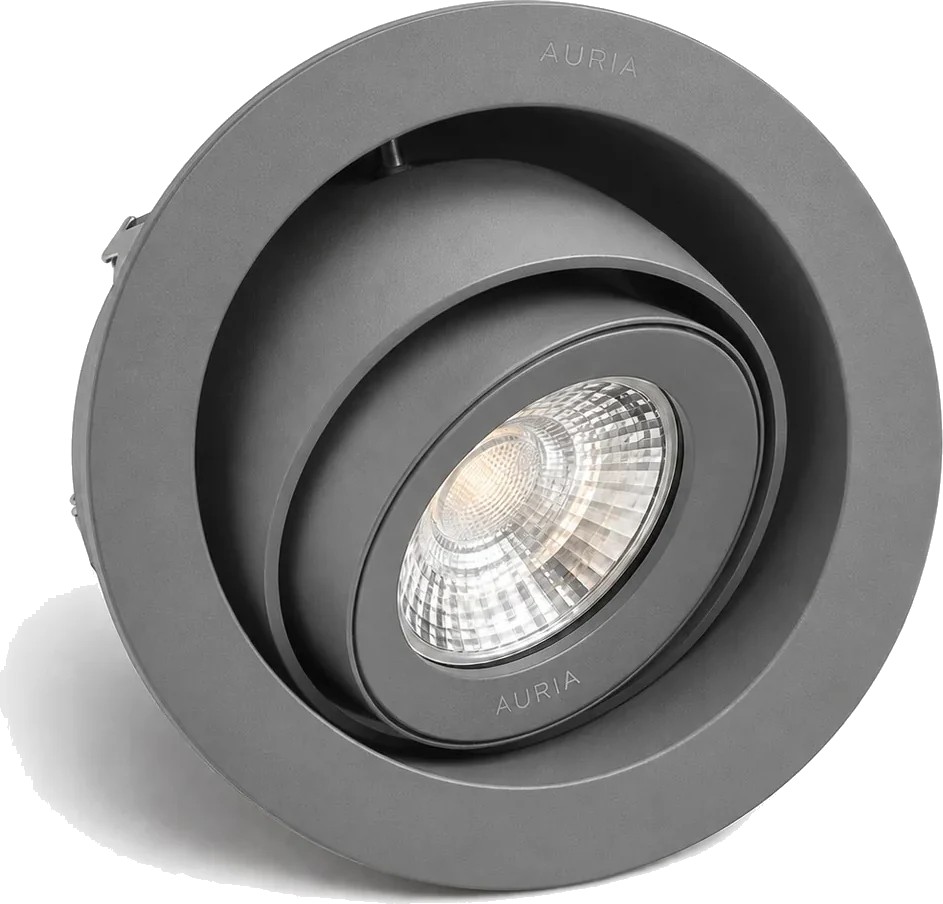
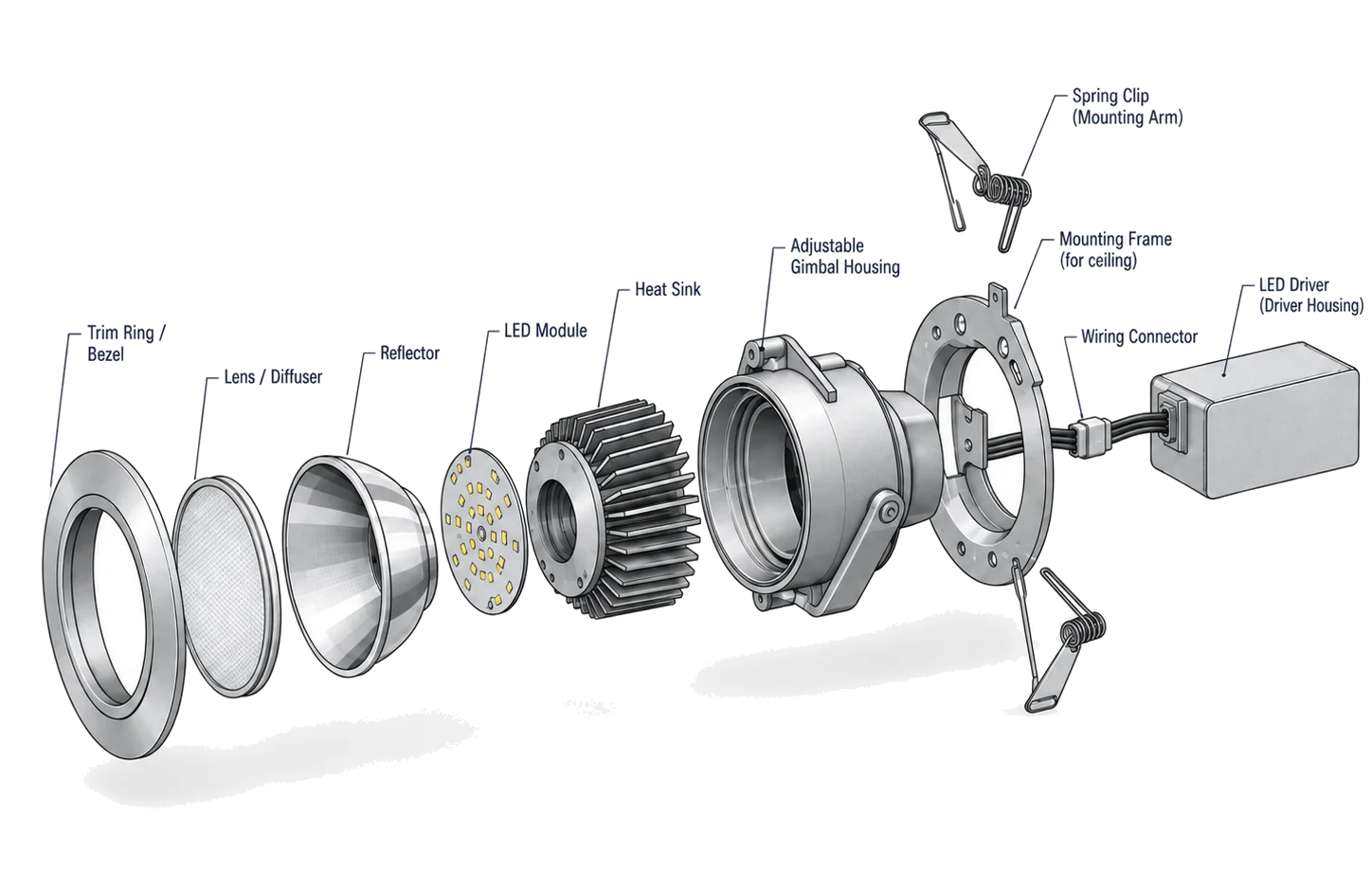
AURIA adjustable LED fixture
A recessed adjustable downlight sold as a family, ordered as a configuration and shipped as a coded sellable product. Eleven ordering decisions, a driver and kit catalog beside it, four simultaneous classifications and three audiences who each want the specification written differently.
Eleven decisions, one fixture. And not every combination can be built.
01 Eleven decisions, one fixture
One configuration of this fixture is eleven separate choices. Not one of them is exotic on its own. Multiplied, they are the reason the catalog was living in a spreadsheet nobody fully trusted.
DecisionReal optionsCountCombinations
Trim / trimlessTrimRound trimlessSquare trimlessMillwork×44
Delivered lumens1,000 lm1,400 lm1,500 lm1,800 lm+1 more×520
Color temperature2700 K3000 K3500 K4000 K+4 more×8160
Beam20° narrow31° medium44° medium flood55° wide flood+1 more×5800
Front opticNoneHoneycombSoft lensLight-bending lens+2 more×64,800
Inner opticNoneLight-bending filmLinear spread filmColor gel film×419,200
DimmingTRIAC / ELV0–10 VDMXPoE×476,800
EmergencyNoneEmergency backup×2153,600
MountingRemodelNew constructionC-channelIC box×4614,400
ShippingCompleteRough-in first×21,228,800
Finish colorBlackWhiteGrayCream+1 more×56,144,000
6,144,000raw combinationsEleven dropdowns, multiplied out — before anyone asks which of them can actually be built.
Every option, in full
The counts above are the manufacturer's. Two of them — dimming and mounting — arrived as open lists ending in “etc.” and are held at four apiece rather than guessed upward: a figure a reader can reproduce is worth more than a bigger one they cannot. The real numbers only move the total up.
- Trim / trimless
- Trim, round trimless, square trimless, millwork.
- Delivered lumens
- 1,000 / 1,400 / 1,500 / 1,800 / 2,000 lm.
- Color temperature
- 2700 / 3000 / 3500 / 4000 / 5000 K, plus Vivid, Dim-to-warm and Tunable white.
- Beam
- 20° narrow, 31° medium, 44° medium flood, 55° wide flood, wall wash.
- Front optic
- None, honeycomb, soft lens, light-bending lens, linear spread, color gel.
- Inner optic
- None, light-bending film, linear spread film, color gel film.
- Dimming
- TRIAC / ELV, 0–10 V, DMX and PoE, plus the vendor control systems the manufacturer supports. Each implies its own driver.
- Emergency
- None, or an emergency backup pack.
- Mounting
- Remodel, new construction, C-channel, IC box.
- Shipping
- Complete, or rough-in shipped first so the trade can close the ceiling before the fixture arrives.
- Finish color
- Black, white, gray, cream, blue. The only one of the eleven that changes nothing about how the fixture performs — and the last segment of the ordering code.
02 An option is not a string
“14” is not the text fourteen sitting in a dropdown. It is a record, and each consumer of the catalog reads the part it needs: the ordering code goes into the SKU, the value and unit onto the datasheet, the CRI to the specifier.
- Ordering code
- 30
- Color temperature
- 3000
- Unit
- K
- CRI
- 90+
- Ordering code
- N
- Beam type
- Narrow
- Beam angle
- 20
- Unit
- degrees
Why this is the load-bearing decision
A dropdown of strings can only ever be printed. Once an option carries its own attributes, one choice fills the ordering code, the specification table, the search filter and the distributor's required column at the same time — and a correction to 3000 K reaches all four. Everything further down this page rests on it: the SKU can only be generated because each segment knows its own code, and a rule can only be written because each option is a value the rule can test.
03 Every piece of data has a place
Written once at the level where it is actually true, and read everywhere below it. The warranty statement is not copied onto ten thousand configurations, and the beam angle is not stored on a family that has five of them.
-
Family AURIA
- Family description
- General installation
- Warranty and compliance
- Brand assets
Written once. Everything below inherits it.
-
Configuration AURIA 3
- Delivered lumens
- Color temperature
- Beam angle
- Driver and dimming
Where the eleven decisions are actually made.
-
Sellable product AU-T-14-30-N-A-C-05-CN
- Ordering code
- Full specification
- Documents and assets
- Channel representations
Nothing is typed here. It is what the two above resolve to.
What it costs when the levels are missing
Without them, everything true of the family is stored once per sellable product — so a corrected installation note is a find-and-replace across the whole catalog, and the one row it misses is the one a distributor publishes. With them the note has exactly one home. A configuration may still override an inherited value where it genuinely differs; what it cannot do is drift from it silently.
04 Not every combination is valid
This is the knowledge that normally lives in a sales engineer's head and leaves when they do. Here it is set up: nothing can offer a combination the factory cannot build, so no order needs rescuing afterwards.
Values depend on each other
- Spot beam — only the compatible lumen engines
- Tunable white — only the compatible lumen outputs and drivers
- Commercial 0–10 V driver — non-IC lumen configurations only
- Remodel mounting — IC box lumen configurations excluded
Product logic belongs in the setup
-
IF
Delivered lumens = 1800THENIC mounting is not available -
IF
Dimming input = 347 VTHENVoltage = 347 V -
IF
Driver type = PoETHENDriver = None
Where the rules run
The same definitions run in three places: the editor, where an invalid pairing is refused as it is made; the importer, where a supplier file carrying one is rejected with the row and the reason; and export, where a configuration that violates a rule never reaches a channel. That is the difference between a product model and a spreadsheet with validation on one tab — the constraint is a property of the product, not of the file somebody happened to open.
05 The SKU is an output, not an input
Nobody types this code. It is what the configuration spells once the eleven decisions are made — which is why it can never disagree with the product it names, and why reading one backwards is a parse rather than a guess.
AU
Family
T
Trim
14
Lumens
30
Color temp
N
Beam
A
Front optic
C
Inner optic
05
Dimming
CN
Mounting
BK
Finish
What generating the code fixes
Hand-built ordering codes fail in one direction and then the other. First the code says 3000 K and the record says 3500 — two sources of truth, and the printed one wins for the customer. Then the reverse: an order arrives with a code nobody can decode, because whoever invented the scheme has left. Generating it removes both. The segments here are the option records from step two; the code is their ordering codes in an agreed order.
06 More than parent and variant
A fixture is not only a child of its family. It requires a driver, fits certain kits and carries its own documents — and each of those is a record with a life of its own, not a text field on the product.
Sellable configuration
AU-T-14-30-N-A-C-05-CN
- is a variant of AURIA 3 Product family
- requires DRV-010-277 Driver
- is compatible with KIT-2204-T Installation kit
- has documents Photometric report, installation sheet EN / ES 3 assets
The same edge, read from the other end
- Input voltage
- 120–277 V
- Dimming protocol
- 0–10 V
- Tunable white
- Yes
- Compatible with
- 1,000 lm and 1,400 lm configurations
- Used by
- 14 configurations
Why the reverse view is the whole point
“Used by 14 configurations” is not stored anywhere. It is the same relationship the configuration declares, counted from the driver's side. That is what makes an end-of-life answerable in a second instead of a week: “what breaks if this driver goes away” has an answer, it is a list, and it is current. The same holds for a kit, a document or a compliance certificate.
07 Four classifications, one product
Where a product sits in your own structure is not where it sits in your internal tree, and neither is where a distributor files it or where an industry standard puts it. All four are true at once and none of them is “the” category.
- Product structure AURIA family AURIA 3 Sellable configuration
- Internal taxonomy Lighting Downlights Adjustable
- Distributor 1 Indoor lighting Commercial fixtures Recessed downlights
- ETIM class Downlight / spot / floodlight EC001744
Why one tree is never enough
A catalog with a single category tree forces a choice between the structure engineering needs, the one the website navigates and the one each distributor demands in their feed — and whichever wins, the others get maintained in a spreadsheet beside it. Holding them as separate classifications of the same product means a distributor reorganizing their tree is a mapping change, not a re-categorization of the catalog. ETIM is the industry's own standard; the class code goes into the feeds that ask for it, unchanged.
08 One model, different outputs
The specifier, the distributor's feed and the website want the same fixture described three incompatible ways. None of them is a separate record. The underlying product does not change — only the representation does.
Engineering
3000 K · CRI ≥90 · 1,400 lm · 20° · 120–277 V
Distributor
MPN · Lumens · CCT · CRI · Beam · Voltage · Dimming
Website
AURIA Adjustable LED Fixture — 1,400 lm · 3000 K · 90+ CRI · 20° narrow beam
Three shapes, one source
Each of these is a channel mapping over the same record: which attributes appear, in what order, under whose column names, with which units and rounding. Add a distributor and you add a mapping, not a catalog. Change 3000 K to 3500 K on the configuration and all three outputs change on the next export, together, because there was only ever one place it was written.
Bring us the product that breaks your spreadsheet
Not the easy one. The family with the option matrix, the rules nobody has written down and the ordering code somebody maintains by hand. That is the one worth modeling in front of you.