
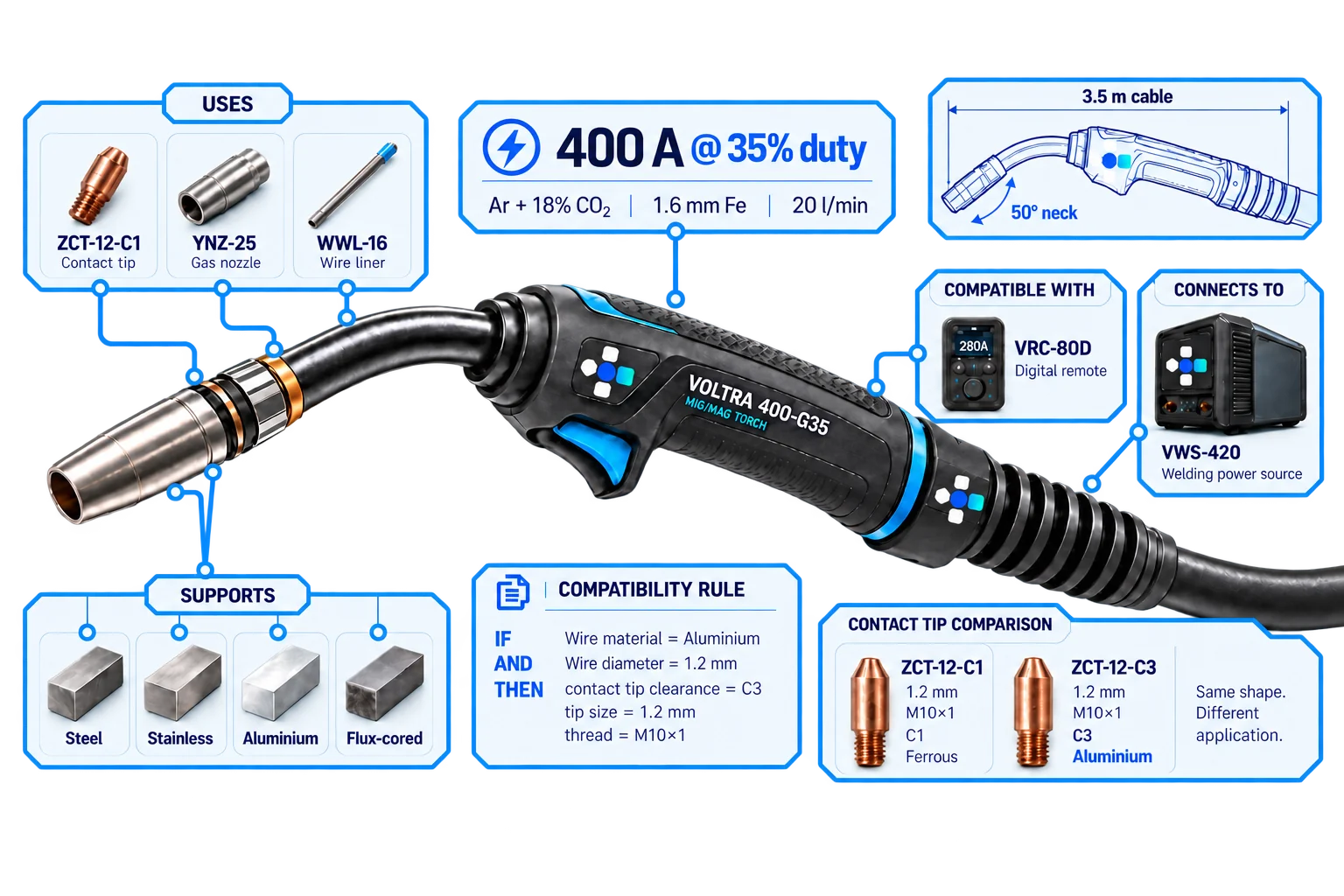
- Value
- 400
- Unit
- A
- Duty cycle
- 35%
- Shielding gas
- Ar + 18% CO₂
- Test wire material
- Fe
- Test wire diameter
- 1.6 mm
- Test gas flow
- 20 l/min
- Wire range
- 0.8–1.6 mm
- Contact-tip thread
- M10×1
Welding equipment · Torches and consumables
VOLTRA MIG/MAG welding station
A torch's headline current is only true under a stated duty cycle, gas and test wire — so the value carries them. And the correct consumable follows from what is being welded rather than from a list of compatible parts, which is what makes a spare-parts catalog answerable instead of merely long.
The rating means nothing without its conditions.
01 A configuration says how it can be used
Nine decisions, and between them they do not describe which variant was picked so much as what the torch is allowed to do — what it can weld, at what load, with which wire, for how much of the hour.
What defines one torch
- Series
- Series A, Series B
- Cooling
- Gas or liquid
- Welding output
- 300 / 400 / 500 A
- Cable length
- 3.5 m, 5 m
- Neck
- Standard, rotating, changeable
- Connection
- Euro, or Euro + control
- Wire material
- Steel, stainless, aluminum, flux-cored
- Wire diameter
- 0.8–1.6 mm
- Remote control
- None, analog, digital
Three marked, and they are the three that carry the rest of the page: the output is the number that needs conditions, and the wire material and diameter together decide which consumables are the right ones.
Why “which variant” is the wrong question here
A torch is bought to do a job, and the job is described in terms the torch's part number does not contain: this alloy, this thickness, this duty. Two customers ordering the same code need different consumables and will wear them out at different rates. So the useful catalog is not a list of variants with a compatibility appendix — it is a model that can answer “for this wire, at this diameter, what do I order”, which is section three.
02 A number without its conditions is not a specification
“400 A” on its own is marketing. 400 A at 35% duty, under Ar + 18% CO₂, tested with 1.6 mm ferrous wire at 20 l/min is a specification — and it is the second one an engineer can hold you to.
The conditions are not footnotes under the figure. They are part of the value, stored with it, and they travel with it into every datasheet, feed and product page that quotes the 400.
What a bare number costs downstream
Three things, all of them expensive. A distributor filtering on “400 A” ranks a 35% torch against a competitor's 60% torch as equals. A specifier comparing datasheets cannot, and will assume the worse case or ask. And a returns argument about a torch run at 400 A continuously has no document to point at. Keeping the conditions attached to the value costs seven fields and removes all three — and it is the same modeling move as the lighting study's option records and the pneumatics study's dimension set: a value is a record, not a string.
03 The right consumable depends on the job
One torch supports four wire materials across a diameter range, and the correct contact tip depends on both at once. This is where a compatibility list stops being enough and a rule has to say why a part belongs with a configuration, not merely that it does.
What decides a consumable
- Ferrous wire — C1 clearance
- Stainless steel wire — C2 clearance
- Aluminum wire — C3 clearance
- Wire diameter — the matching contact-tip size
- Torch — the thread the tip must have
As the setup stores it
-
IF
-
Wire material = Aluminum -
AND
Wire diameter = 1.2 mm
THENContact-tip clearance = C3Contact-tip wire size = 1.2 mmThread = M10×1
-
-
IF
Torch series = Series BTHENdigital remote VRC-80D is compatible -
IF
Torch series = Series ATHENanalog remote VRC-50A is compatible
Two conditions, three consequences, one rule. A flat “compatible accessories” list can hold the answer but not the reason, which means it cannot be checked, cannot be asked a question, and has to be rebuilt by hand every time a wire size is added.
Answering the question the customer actually asks
Nobody asks which contact tips are compatible with their torch. They ask what to order to weld 1.2 mm aluminum — and the difference between those two questions is the difference between a list the customer has to filter and an answer the catalog can give. The same rule also runs backwards: given a tip, which jobs it is the right one for. That is the spare-parts view in section five, and it is generated rather than written.
04 The torch sits inside a compatibility network
Consumables, accessories and connected equipment, each related to the torch in a different way. A contact tip is consumed; a remote is chosen; a power source is connected; a wire material is neither a part nor an accessory.
Torch configuration
VOLTRA 400-G35
- uses ZCT-12-C1YNZ-25WWL-16 Consumables — tip, nozzle, liner
- supports SteelStainlessAluminum Wire materials — not products
- is compatible with VRC-80D Digital remote
- connects to VWS-420 Welding power source
“Uses” is the one with a lifecycle: those three are worn out and reordered, which makes the edge a recurring revenue line rather than a compatibility note. “Supports” again points at properties rather than parts.
Why the consumable edge is the valuable one
A torch is sold once and its consumables are sold for as long as it runs, so the edge that says which tip fits which job is the one the aftermarket is built on. Held as a relationship it can be read from the tip's side (which torches and jobs is this the right part for), priced as a pack, given a replacement interval, and put in front of a customer who already owns the torch. Held as prose on a datasheet it can be read by a person, once.
05 And the parts are full records too
A consumable has as much structured data as the torch, and some of it — pack quantity, replacement interval, clearance class — exists only because it is a consumable.
- Wire diameter
- 1.2 mm
- Wire material
- Steel, ferrous
- Clearance class
- C1
- Thread
- M10×1
- Material
- CuCrZr
- Overall length
- 35 mm
- Bore diameter
- 1.3 mm
- Consumable
- Yes
- Pack quantity
- 10
- Replacement
- On wear
FITS → VOLTRA 400-G35, 1.2 mm ferrous
- Wire diameter
- 1.2 mm
- Clearance class
- C3
- Recommended material
- Aluminum
- Thread
- M10×1
- Torch family
- VOLTRA
- Configurations
- By torch and wire range
FITS → VOLTRA, 1.2 mm aluminum
- Processes
- MIG, MAG, Pulse MIG
- Current range
- 40–420 A
- Duty at 420 A
- 60%
- Duty at 350 A
- 100%
- Input
- 400 V, 3-phase, 50/60 Hz
- Wire range
- 0.8–1.6 mm
- Shielding gases
- CO₂, Ar/CO₂, Argon
- Cooling support
- Gas and liquid
- Digital torch control
- Yes
- Memory channels
- 99
- Protection rating
- IP23
- Operating temperature
- −20 to +40 °C
CONNECTS TO → VOLTRA 400-G35 · SUPPORTS → VRC-80D
Note the two tips: same 1.2 mm wire, same M10×1 thread, different clearance class — and that single difference is the whole reason section three's rule has to test the material as well as the diameter.
Two records that differ in one field
C1 and C3 have the same object structure and are not interchangeable: fit the ferrous tip to an aluminum job and the wire binds. Nothing about the part number, the thread or the wire size distinguishes them to a person ordering in a hurry, which is exactly why the choice belongs to a rule and not to a dropdown of compatible parts. The power source is here for a different reason: it carries its own duty-cycle pair, so the system's real limit is the lower of its curve and the torch's — a question that can only be asked because both are modeled.
06 One model, four outputs
The engineer wants the qualified specification, the service desk wants the right spare, the distributor wants their columns and the website wants a sentence. The spare-parts view is the one that is generated from the rules rather than written.
Engineering
- Series: Series B
- Cooling: Gas
- Load capacity: 400 A @ 35%
- Shielding gas: Ar + 18% CO₂
- Wire range: 0.8–1.6 mm
- Contact-tip thread: M10×1
- Neck angle: 50°
- Operating temperature: −20 to +40 °C
- Standard: IEC 60974-7
Spare parts
- Compatible contact tips
- Compatible gas nozzles
- Compatible wire liners
- Compatible remote controls
- Correct consumables by wire material and diameter
Distributor export
- Product code
- Cooling type
- Rated current
- Duty cycle
- Cable length
- Wire diameter
- Connection
- Compatible consumables
Website
VOLTRA 400 MIG/MAG Welding Torch — 400 A · gas cooled · 0.8–1.6 mm wire · 3.5 m cable
Read the second card against section three: every line of it is a query over the same rules, not a list somebody maintains. That is the difference between a spare-parts catalog that is current and one that was current when it was written.
How channels and exports workFour audiences, and the one that pays for itself
The engineering, distributor and website views are projections of one record, the same as in the other three studies. The spare-parts view is different in kind: it is the rules run in reverse, and it is the output with a direct revenue line behind it, because a customer who can find the right consumable in thirty seconds orders it from you instead of from whoever stocks a generic equivalent. It is also the view that is impossible to keep accurate by hand once there are four wire materials, a diameter range and more than one torch series.
Bring us the product that breaks your spreadsheet
Not the easy one. The family with the option matrix, the rules nobody has written down and the ordering code somebody maintains by hand. That is the one worth modeling in front of you.