
- Channels
- 16
- Input type
- Sink / source
- Nominal input voltage
- 24 V DC
- Input voltage range
- 18–30 V DC
- Isolation
- Channel-to-bus
- Current consumption
- 85 mA
- Module width
- 20 mm
- Bus type
- ORVEX local bus
- Required firmware
- Controller ≥ 3.2
Industrial automation · Control systems
ORVEX C400 modular control system
There is no SKU for this system. It is assembled from products that are each sold separately, so the catalog has to hold the components, the rules between them and the system they add up to — including a bus-current budget calculated from whatever is actually in it.
The product is a set, with constraints between the components.
01 Assembled, not selected
There is no SKU for this. A control system is built from independent products that are each sold separately — so the catalog has to describe the components and the valid system they add up to, and neither one is derivable from the other alone.
One system, as ordered
- Controller
- C400-CPU
- Power supply
- PS-24-120
- Communication
- Ethernet/IP, Modbus TCP, PROFINET
- Digital inputs
- DI-16-24
- Digital outputs
- DO-16-24
- Analog inputs
- AI-8-U
- Analog outputs
- AO-4-U
- Expansion
- Local or remote I/O
- HMI
- HMI-700
- Operating voltage
- 24 V DC
Every line is a product with its own price, stock, datasheet and lifecycle. The system is the relationship between them, and that is the thing a flat catalog has nowhere to put.
Why an assembly breaks the usual model
A configured product resolves to one sellable thing with one code. An assembled system does not: the customer buys eight line items, and what makes the order correct is a property of the set rather than of any member of it. Catalogs that only know products push that check onto a sales engineer with a spreadsheet; catalogs that only know kits lose the ability to sell a spare module. The model has to hold both, which is what the rest of this page is about.
02 A module is a product, with its own specification
The controller does not carry an attribute saying “8 analog inputs”. The analog input module is a separate product, with specifications the system needs and constraints the system has to respect.
- Channels
- 8
- Supported signals
- 0–10 V, ±10 V, 4–20 mA
- Resolution
- 16 bit
- Accuracy
- ±0.1%
- Current consumption
- 140 mA
- Module width
- 20 mm
- Isolation
- Group isolated
Two of those lines do double duty. Current consumption is what the budget in section four is calculated from; required firmware is what the rule in section three tests.
The attribute-on-the-controller shortcut, and what it costs
Writing “analog inputs: 8” on the controller is the shortcut, and it is wrong in three directions at once. The module cannot be sold or stocked on its own; its 140 mA never reaches a power calculation; and its firmware requirement has nowhere to live, so the incompatibility surfaces on a commissioning engineer's laptop instead of in the order. Modeling it as a product with relationships costs one record and removes all three.
03 A valid system depends on the combination
No single component is wrong on its own. What can be wrong is the set — too many modules for the controller, a module the firmware is too old for, a protocol nothing on the rail actually speaks.
What has to hold across the set
- Local I/O count — bounded by the controller, not by the rack
- Firmware level — the highest requirement of any module installed
- Protocol support — native on the controller, or added by a module
- Bus current — the sum of every consumer, against the supply's capacity
As the setup stores it
-
IF
Controller = C400-CPUTHENMaximum local I/O modules = 16 -
IF
AI-8-U is installedTHENController firmware ≥ 3.2 -
IF
Communication protocol = PROFINETTHENa PROFINET module is present, OR the controller has native PROFINET support
The third rule is the interesting one: it is satisfied two different ways, and which way changes the bill of materials. A rule engine that can only test one condition against one field cannot express it.
Where a combination rule has to run
Later than a field rule, and in more places. A field rule can be checked as the value is typed; a combination rule has no meaning until the set is complete, so it runs when the configuration is submitted, when a line is added to a quote, and again when a module in it is superseded. The last one matters most: a system that was valid when it was quoted can stop being valid because a component changed, and the only way to know is to be able to re-evaluate the set.
04 The system's requirements are calculated from its parts
Every controller and module draws current from the internal bus. Add them up, compare against what the supply provides, and the answer is a property of the configuration — not a number somebody maintains for each of the combinations that could be ordered.
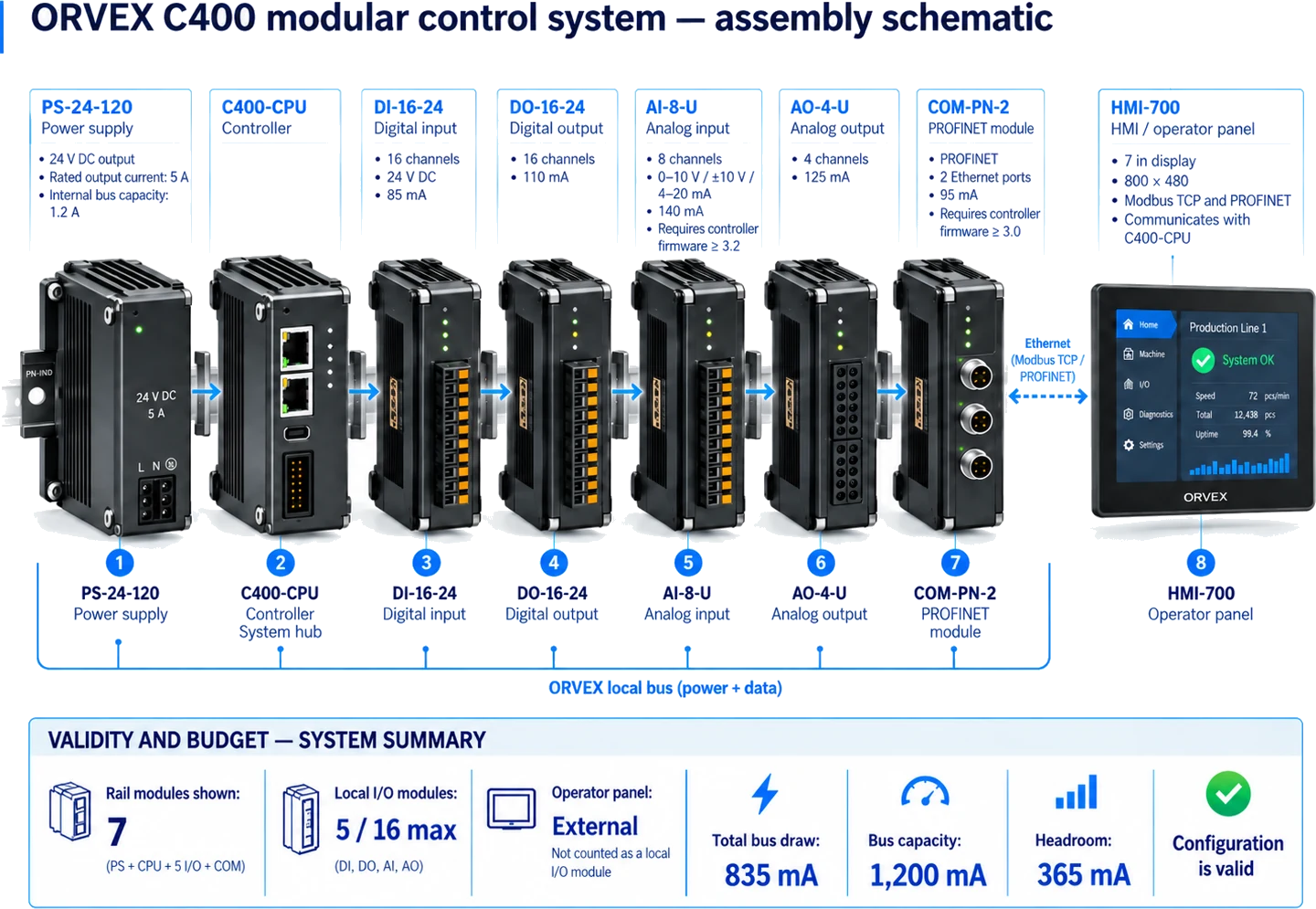
- C400-CPU Controller 280 mA
- DI-16-24 Digital input 85 mA
- DO-16-24 Digital output 110 mA
- AI-8-U Analog input 140 mA
- AO-4-U Analog output 125 mA
- COM-PN-2 Communication 95 mA
Total bus draw 835 mA
- Available from PS-24-120
- 1,200 mA
- Headroom
- 365 mA
Configuration is valid
Add a seventh module and the total moves. Cross 1,200 mA and the configuration is flagged, with the remedy named: a larger supply, or an additional power segment.
Why this is derived rather than stored
The alternative is a stored power figure per configuration, and there is no bounded set of configurations to store it for — that is what section one is about. Deriving it means a corrected consumption figure on one module reaches every system that contains it, immediately, including the ones already quoted. The same arithmetic answers the question from the other side too: how many more modules of a given type will this supply carry.
05 The relationships are not all the same relationship
A power supply is not a variant of a controller. An I/O module is not an accessory in the way an operator panel is. A protocol is not a product at all. Flatten those into one “related products” list and every one of them stops being answerable.
Controller
ORVEX C400-CPU
- is powered by PS-24-120 Power supply
- accepts DI-16-24DO-16-24AI-8-UAO-4-U I/O modules, up to 16 local
- communicates with HMI-700 Operator panel
- supports Modbus TCPEthernet/IPPROFINET Protocols — not products
Four verbs, four different meanings. “Supports” does not point at anything sellable, and that is exactly why it needs to be its own kind of edge rather than a line in a compatibility text field.
What typed edges buy you
Each verb answers a different question, and answers it from both ends. “Is powered by” drives the budget in section four. “Accepts” is what the local-I/O limit counts, and read backwards it tells a module which controllers it fits. “Supports” is what the PROFINET rule tests, and it is satisfied by a property rather than by a part. Collapse them into one list of related products and all three questions become a human reading a compatibility table.
06 And each of those is a full record too
The things on the other end of those edges are not stubs. They are products with their own specifications, their own datasheets and their own lifecycle — and the edge type is stored with them.
- Input voltage
- 100–240 V AC
- Output voltage
- 24 V DC
- Rated output current
- 5 A
- Internal bus capacity
- 1.2 A
- Efficiency
- 91%
- DIN rail mounting
- Yes
- Operating temperature
- −20 to +60 °C
- Controller family
- ORVEX C400
POWERS → C400 control systems
- Display size
- 7 in
- Resolution
- 800 × 480
- Touch interface
- Capacitive
- Supply
- 24 V DC
- Ethernet ports
- 2
- Protocols
- Modbus TCP, PROFINET
- Protection rating
- IP65 front
- Compatible controller
- C400-CPU
COMMUNICATES WITH → C400 controllers
- Protocol
- PROFINET
- Ethernet ports
- 2
- Port speed
- 100 Mbps
- Current consumption
- 95 mA
- Module width
- 20 mm
- Required firmware
- Controller ≥ 3.0
- Compatible controller
- C400-CPU
ADDS PROTOCOL → PROFINET
The third card is how the PROFINET rule gets satisfied, and its 95 mA is the sixth line of the budget. Nothing on this page is quoted twice; it is one record being read by three different sections.
The edge type belongs to the relationship, not the product
“Powers”, “communicates with” and “adds protocol” are properties of the link, which is why they can be read from either side and why one product can hold several of them at once. A communication module both adds a protocol to a controller and draws current from its bus; those are two edges, not one ambiguous association, and the budget only counts the second.
07 One model, four outputs
The engineer wants the resolved system, purchasing wants a bill of materials, the distributor wants their columns and the website wants a sentence. The bill of materials is the one a configured-product model cannot produce at all.
Engineering
- Controller: C400-CPU
- Digital inputs: 16
- Digital outputs: 16
- Analog inputs: 8
- Analog outputs: 4
- Network: PROFINET
- Bus consumption: 835 mA
- Bus capacity: 1,200 mA
- Local modules: 5 / 16
Bill of materials
- 1 × C400-CPU Controller
- 1 × PS-24-120 Power supply
- 1 × DI-16-24 Digital input
- 1 × DO-16-24 Digital output
- 1 × AI-8-U Analog input
- 1 × AO-4-U Analog output
- 1 × COM-PN-2 Communication
- 1 × HMI-700 Operator panel
Distributor export
- Product code
- Product type
- Voltage
- Channel count
- Signal type
- Protocol
- Power consumption
- Compatible controller
- Firmware requirement
Website
ORVEX C400 Modular Control System — 24 V DC · modular I/O · PROFINET · Modbus TCP · Ethernet/IP
Read the first two together: 835 mA and 5 / 16 in the engineering view are the budget from section four and the count bounded by the controller's rule, and every line of the bill of materials is a node from section five. One model describes the components, the rules between them, and the system they make.
How channels and exports workWhy the bill of materials is the hard one
The other three are projections of one record. A bill of materials is a projection of the whole set, with quantities, and it has to stay in step with a configuration that can change after it is quoted. It is also the output the customer actually orders against, so it is the one where a stale figure becomes a wrong delivery rather than a wrong web page. Generating it from the same relationships the validity rules and the budget read is what keeps the three from disagreeing.
Bring us the product that breaks your spreadsheet
Not the easy one. The family with the option matrix, the rules nobody has written down and the ordering code somebody maintains by hand. That is the one worth modeling in front of you.